reports & consultations
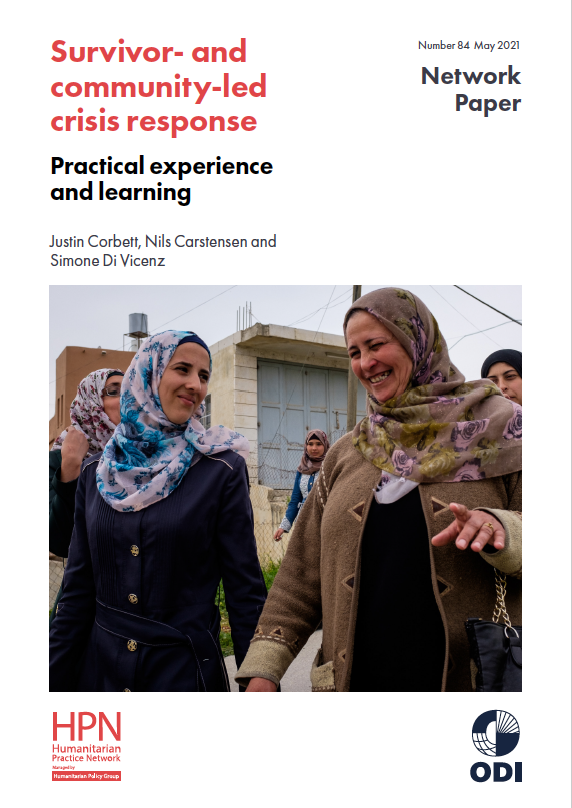
Survivor- and community-led crisis response: practical experience and learning
Published: 2021
Author: Justin Corbett, Nils Carstensen and Simone Di Vicenz for The Humanitarian Practice Network at ODI
“This Network Paper introduces and explains existing knowledge and experience with an emerging way of working in humanitarian programming. For now, we call this approach ‘survivor- and community-led crisis response’ or ‘sclr’, as it seeks to enable external aid actors to connect with, support and strengthen crisis responses identified, designed, implemented and monitored by existing or new self-help groups among crisis-affected populations.”
‘There is nothing for us without us’: Evaluation of a Multi-District Pilot Scale Up of Community-Led Child Protection in Sierra Leone
Published: 2024
Author: Drs. Kathleen Kostenly and Mike Wessells
A case study of how community-led child protection approach was scaled up in Sierra Leone.
Horizontal spread of community-owned protection: A case study from Marafa, Kenya
Published: 2023
Author: Kathleen Kostelny, Ken Ondoro, and Michael Wessells
“In an era of localization of aid and calls to share more power with communities, a valuable questions to be asked include ‘How could local people scale up a child protection intervention?’ and ‘What would a scale up effort driven by local communities look like, and could it achieve positive outcomes for children?’ “
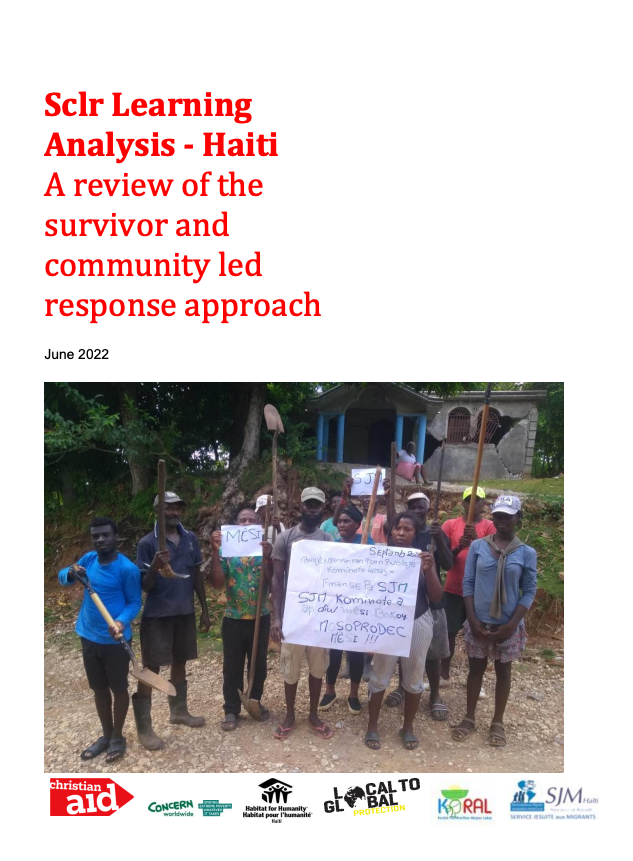
Sclr Learning Analysis – Haiti A review of the survivor and community led response approach
Published: 2022
Author: Jessica Dolcy and Duquesne Prophete for Christian Aid
“On Saturday 14th August 2021 a 7.2 magnitude earthquake struck southwestern Haiti with devastating consequences. Christian Aid worked with local partner organisations Konbite pou Ranfose Aksyon Lakay (KORAL) and Service Jésuites aux Migrants (SJM) to implement the Haiti Earthquake Response which would test the sclr approach at scale for the first time in a complex emergency response in Haiti.”
Are we there yet? Localisation as the journey towards locally-led practice: Models, approaches and challenges
Published: 2021
Author: Arbie Baguios, Maia King, Alex Martins and Rose Pinnington for ODI
“Localisation and locally led international development practice has long been discussed, but has still not been delivered. Systemic barriers have posed challenges, and the term itself is contested. Now, the last tumultuous 18 months could provide a critical juncture to finally move forward with this crucial agenda. The pandemic has highlighted structural inequalities in the global system, and disrupted ways of working in the international development sector. The Black Lives Matter movement has brought conversations about racism and colonialism to the fore. And the climate crisis has highlighted the need for global action on humanity’s challenges that remain rooted in local realities.”
Key Insights and Findings from the Global Fund for Children Learning Review: Empowering communities to lead their own development
Published: 2024
Author: GFC and Tostan
“Global Fund for Children (GFC) and Tostan have forged a partnership over the past four years based on their shared commitment to promoting community wellbeing and empowering children, youth, women, and men to lead dignified lives. GFC invests in community-based organizations around the world to help children and youth achieve their full potential and advance their rights while Tostan is an Africa-based organization that works directly with networks of rural communities, empowering them to lead their own development. Tostan’s three-year Community Empowerment Program (CEP) has been instrumental in facilitating community-led initiatives, particularly in the realms of human rights, health, education, livelihoods, and the environment across entire districts. Tostan’s model emphasizes the importance of community ownership and broad civic engagement and results in sustainable and meaningful change.”

Do No Harm: Challenges in Organizing Psychosocial Support to Displaced People in Emergency Settings
Published: 2008
Author: Michael Wessells
“Psychosocial assistance in emergencies plays an important role in alleviating suffering and promoting well-being, but it is often a source of unintended harm. A prerequisite for ethically appropriate support is awareness of how psychosocial programs may cause harm. This paper underscores the importance of attending to issues of coordination, dependency, politicization of aid, assessment, short-term assistance, imposition of outsider approaches, protection, and impact evaluation. With regard to each of these issues, it suggests practical steps that may be taken to reduce harm and maximize the humanitarian value of psychosocial assistance.”
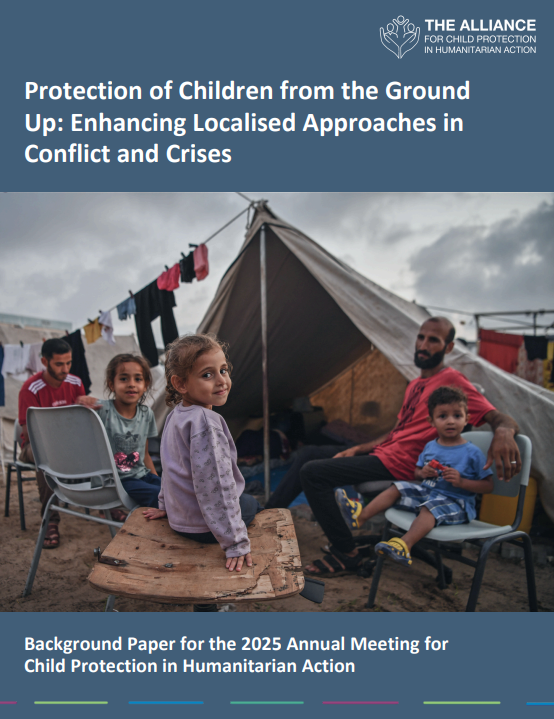
Protection of Children from the Ground Up: Enhancing Localised Approaches in Conflict and Crises – Background Paper
Published: 2025
Author: The Alliance for Child Protection in Humanitarian Action
This paper begins with briefly introducing the focus of this year’s theme, providing key definitions and concepts being used in the paper, and defining three focus areas within the broad spectrum of approaches that facilitate localised, ground-up child protection. These are: 1. Strengthening context-relevant and community-owned child protection 2. Strengthening local systems and actors, including leadership 3. Child and community engagement in project cycles to facilitate accountability.
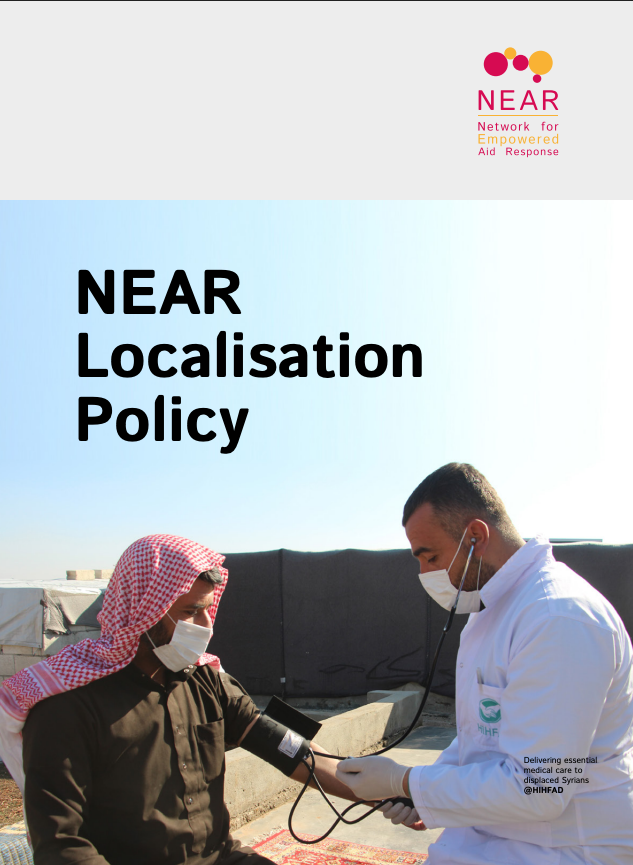
NEAR Localisation Policy
Published: 2025
Author: NEAR
“This policy note outlines NEAR’s position on localisation. Localisation is a central issue for us as it is essential to our vision and our mission. We see localisation as a solution to the current challenges faced by the humanitarian system when responding to the needs of people affected by crises. In this policy note, we set out NEAR’s definition of localisation and the change we believe is necessary to better meet the needs of people in crises.”
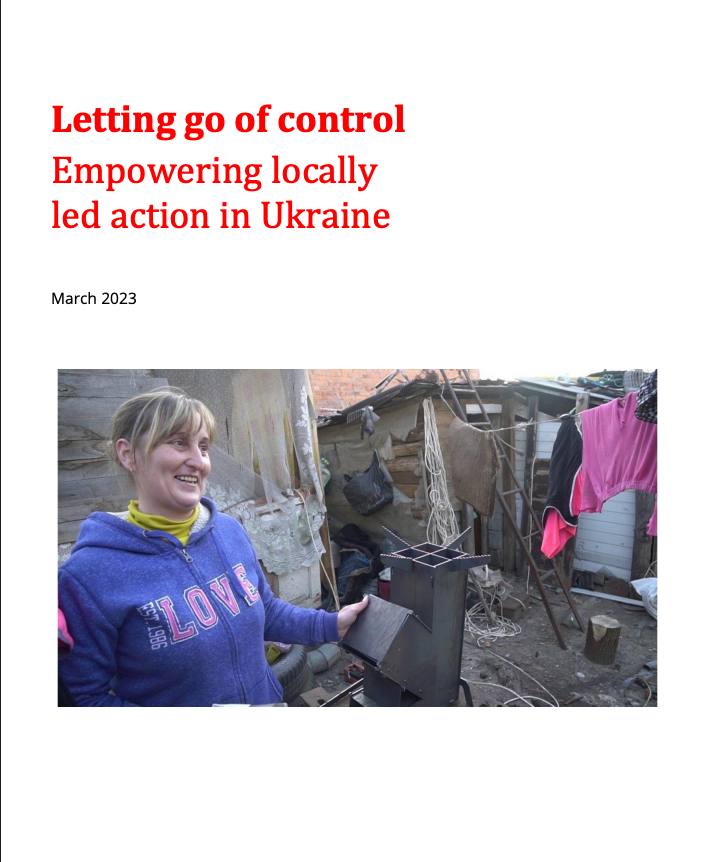
Letting go of control – Empowering locally led action in Ukraine
Published: 2023
Author: Simone Di Vicenz & Elizabeth Hallinan for Christian Aid
“In the first weeks of the war after Russia’s invasion of Ukraine, ordinary people, host communities and spontaneous community groups sprang into action as first responders together with other local actors, including Ukrainian NGOs, church groups and volunteers. These first responders organically formed a humanitarian response based on their own resources and networks, connecting with like-minded helpers and local governments to expand and scale up.”
Voice for Change – Agrarian Communities’ Action Plan on Climate Change
Published: 2015
Author: Praxis Institute for Participatory Practices
Democratising global policy making and processes through participatory research.
A Participatory Approach to Child Protection in Implementing Mission Vatsalya
Published: 2024
Author: Inter-Agency Initiative to Enable Community Participation in Child Protection
Fostering Community Collaboration with Panchayat: Participatory Assessment of Needs and Appetite for Change to Enable Action (PANACEA) 2023-2024. “The introduction of Mission Vatsalya 2021, the erstwhile ICPS Scheme, mandates one of the panchayats’ standing committees to act as the Child Welfare and Protection Committee, emphasizing embedding child protection within local communities. The scheme directs Panchayats to integrate children’s issues into their Gram Panchayat Development Plans (GPDP) and allocates 5% of untied funds for child welfare and protection. These provisions establish vital foundations for promoting child protection at the grassroots level, enabling communities to engage in interventions concerning child welfare and protection, optimize resource allocation, and integrate cultural diversity into child-centric strategies.”
What crisis affected communities need from a humanitarian reset
Published: March 2025
Author: Ground Truth Solutions
A guide based on two years of conversations with people on the front lines of crisis. Over two years and across 12 countries, Ground Truth Solutions held more than 34,000 conversations with people experiencing crisis to find out what they want and need humanitarian action to do for them. They offer some clear priorities that should help us navigate this funding crisis.
The New Ecology of Early Childhood: Revisiting Bronfenbrenner’s theory in the context of contemporary challenges and opportunities
Published: February 2025
Author: Philip A. Fisher, PhD & Joan Lombardi, PhD
Bronfenbrenner’s ecological approach to human development—and early childhood in particular—remains highly influential in scholarly work, policy, and practice, but much has changed since its formulation. This paper proposes an updated version which incorporates more recent learning around neuroscience and the evolving challenges and contexts in contemporary America. The socio-ecological approach is an important framework for community-led child protection.
Reimagining Scaling: Reflections, Principles, and Perspectives on Scaling Locally-led Humanitarian Innovations
Published: 2025
Author: Community-Led Innovation Partnership (CLIP) & Indigenous & Modern
“This report delves into the complexities of scaling locally-led humanitarian innovation, presenting findings from case studies across five countries: Guatemala, Indonesia, the Philippines, Brazil, and Cameroon. Each case showcases unique perspectives on scaling that depart from traditional, Western frameworks — particularly Silicon Valley-inspired models focused on entrepreneurship. For local innovators, scaling is an organic process that emphasises social impact, community ownership, and contextual adaptation over universal application. This report synthesises these examples to provide recommendations on reimagining scaling from a locally-led, decolonial perspective.”
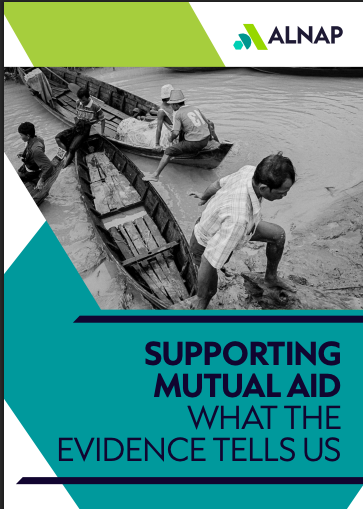
Supporting Mutual Aid – What the Evidence Tells Us
Published: 2025
Author: Posada, A. and Ahimbisibwe, L. for ALNAP/ODI Global
Multi-year research, led by ALNAP in partnership with Local2Global, explores the questions: Could the international system connect to truly locally led efforts? What happens when the conventional humanitarian system engages with and supports informal community-led initiatives?
Building more locally-led aid ecosystems: 2025 insights from Global South civil society. Synthesis of findings.Network for Empowered Aid Response (NEAR)
Published: 2026
Author: Viswanathan, Vijayalakshmi et al.
“Building More Locally-Led Aid Ecosystems is an attempt to bring nuanced insights from Global South civil society on the hopes and struggles of daily realities, as well as their efforts to find a different way forward. Mimicking the realities in which many national and local organisations find themselves, the report looks both within the dominant international system and outside it.”
Building more locally-led aid ecosystems: 2025 insights from Global South civil society. Network for Empowered Aid Response (NEAR).
Published: 2026
Author: Viswanathan, Vijayalakshmi et al.
“Across the sector, localisation has become an accepted idea. It has become the norm for international actors to incorporate country-based expertise into proposals and plans (often at donors’ request); to implement programmes through national and local actors to ensure smooth delivery (with cost-efficiency arguments still often playing a role); and, to a lesser extent, to give visibility to their “local partners”.”
Localizing Child Protection at Community Level – How to Shift Power and Increase Community Ownership
Published: October 2025
Author: Mike Wessells
A Practice Brief – The era of localization presents both key challenges and opportunities in community-level child protection. This brief highlights how shifting power to communities and generating high levels of community ownership is fundamental for localizing child protection effectively and sustainably. It explores how child protection practitioners are key players in supporting a localized, evidence-based, community-led child protection approach.
Localizing Child Protection – Why Community Ownership Matters. Briefing Paper
Published: October 2025
Author: Mike Wessells
A Call to Action for Donors. This briefing paper outlines challenges to localizing child protection at community level in development and humanitarian work. It presents a Call to Action that emphasizes shifting more power to communities and supporting stronger community ownership through the use of community-led and -owned child protection approaches.
Executive Summary: Shifting Power, Localizing, and Strengthening Ownership: Three Country Learnings and Challenges in Community-Led Child Protection
Published: May 2025
Author: Wessells, M., & Kostelny, K. (2025)
Summary version of a synthesis report of research from three countries around community-led child protection with actionable learning around shifting power to communities from child protection.
Shifting Power, Localizing, and Strengthening Ownership: Three Country Learnings and Challenges in Community-Led Child Protection
Published: May 2025
Author: Wessells, M., & Kostelny, K. (2025)
A synthesis report of research from three countries around community-led child protection with actionable learning around shifting power to communities from child protection.
How Process Matters in Strengthening MHPSS: A Reflection
Published: 2023
Author: Michael G. Wessells
In developing the IASC Guidelines on Mental Health and Psychosocial Support in Emergency Settings, attention to social process was key for success. A reflection on this process by one of the authors, Michael G. Wessells.
Community action to reduce child marriage in Shinyanga, Tanzania. Summary report
Published: 2021
Author: Firelight Foundation
This report summarises achievements and learnings from an independent evaluation conducted by the AfriChild Centre of Excellence for the Study of the African Child, CBO grantee-partners’ reports, reports from community dialogues conducted by grantee-partners with their communities, consultant reports, and observations and reflections by Firelight staff.

Integrating MHPSS & peace building: a mapping and recommendations for practitioners
Published: 2023
Author: Michael Wessells, PhD. & Raksha Sule
This is the Report of a Consultancy conducted on behalf of the IASC Thematic Working Group on MHPSS & Peacebuilding within the IASC MHPSS Reference Group. The report was shared and discussed widely in four global consultations conducted July-September, 2022 with young people, grassroots practitioners, and policy and thought leaders.
Ficha de situación – Chocó: Quibdó
Published: 2020
Author: MIRE–Mecanismo Intersectorial de Respuesta a Emergencias
Ficha de situación – Chocó: Quibdó. Comunidades de Villa nueva, Wounaan Phoboor y Wounaan la Paz.
Resguardos De Paz – Módulos Del Proyecto. Maach Thuejen Khun. Estrategia guardianes del bosque, un retorno a las tradiciones
Published: no date
Author: Medardo Rafael Barros B. & War Child Holland, Colombia
Consultoría en derecho propio de la etnia Wounaan del Chocó, Colombia.
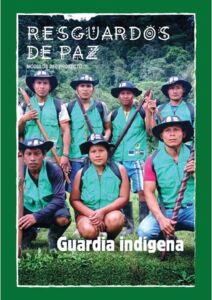
Resguardos de Paz – Módulos del proyecto. Guardia Indígena
Published: no date
Author: War Child Colombia
Una historia de resistencia y protección Guardia Indígena. Acciones para la protección comunitaria, defensa de los derechos humanos y construcción de memoria histórica en comunidades indigenas en los departamentos de Choco y Antioquia, Colombia.
A journey in children’s participation
Published: 2002
Author: The Concerned for Working Children - Compiled and Edited by Nandana Reddy and Kavita Ratna
A document which shares the body of knowledge acquired by the Concerned Working for Children, India, and questons which still need answering.
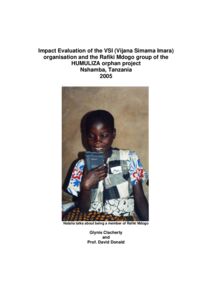
Impact Evaluation of the VSI (Vijana Simama Imara) organisation and the Rafiki Mdogo group of the HUMULIZA orphan project Nshamba, Tanzania
Published: 2005
Author: Glynis Clacherty and Professor David Donald
The aims of the Humuliza Project are to develop a practical instrument to enable
teachers and caregivers to support orphans psychologically and to develop the
orphans’ own capacity to cope with the loss of their caretakers.
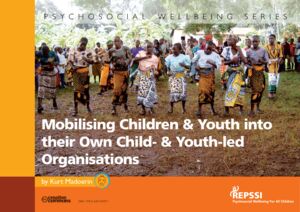
Mobilising Children & Youth into their Own Child- & Youth-led Organisations
Published: 2008
Author: Kurt Madoerin. Published by REPSSI
Several decades of experience in working with vulnerable children across the planet had resulted in Kurt coming to believe that in the face of family, community and societal disintegration, the single most important supportive “intervention” that could be offered “to”, and more importantly “with” children and youth, might be the mobilisation of children and youth into their own child-led and youth-led organisations.
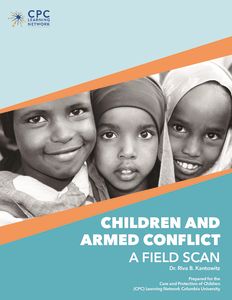
CHILDREN AND ARMED CONFLICT A FIELD SCAN
Published: No date
Author: Riva B. Kantowitz for Care and Protection of Children (CPC) Learning Network Columbia University
This paper seeks to articulate the main trends and challenges in the field of children affected by armed conflict. Its objective is to summarize lessons learned over the last decade, provoke reflection, generate questions and suggest potential strategies to improve the lives of more than one billion children affected by violence and deprivation.
Reconsidering child protection systems: Critical reflections
Published: No date
Author: Bill Forbes, Alexander Krueger, Nicole Behnam, Philip Cook, Mike Wessells and John Williamson
This paper examines the most recent large-scale development in child protection work—the shift from individual child protection projects towards strengthening national child protection systems.
Community-driven systems change
Published: 2021
Author: Firelight Foundation
The power of grassroots-led change for long-term impact, and how funders can nurture it.
Community action to end ‘early sex’ in Kenya: Endline report
Published: 2020
Author: Kathleen Kostelny, Ken Ondoro, & Mike Wessells
An endline study (Oct-Nov 2019) of action research undertaken in Marafa and Bamba, Kenya. The research aimed to develop and test systematically the effectiveness of more community owned processes of child protection that link with formal, government aspects of child protection, and to use the learning from the research to strengthen practice.
Minimum standards for child protection in humanitarian action – 2019 edition
Published: 2019
Author: The Alliance for Child Protection in Humanitarian Action
The updated 2019 edition of this global guidance for minimum standards for child protection in humanitarian action.
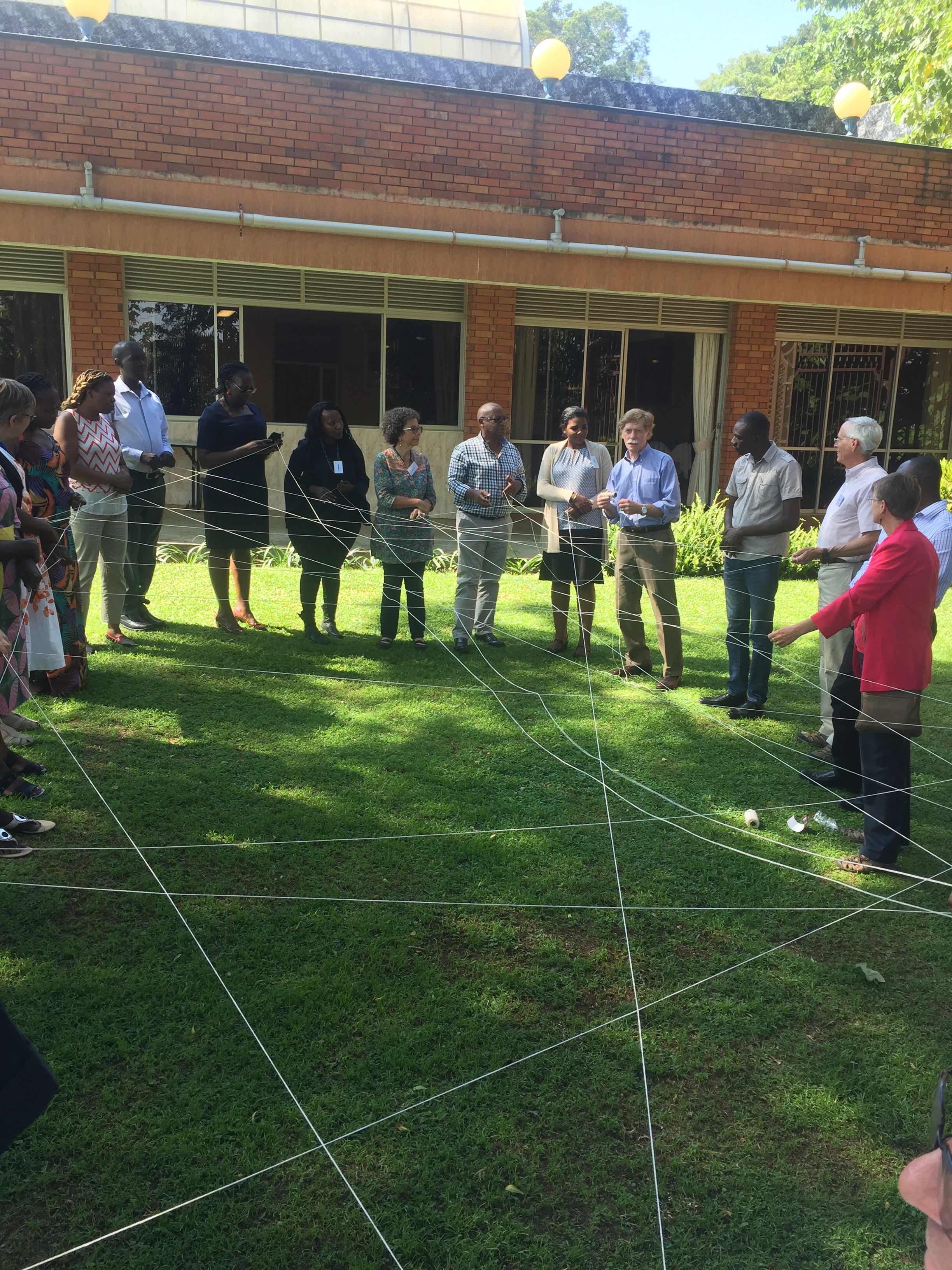
Communiqué from the Interagency Learning Initiative (ILI) on Community-based Child Protection Mechanisms and Systems – Entebbe, Uganda, November 13-15, 2018
Published: 2018
Author: The Interagecy Learning Initiative on Community-Based Child Protection and Systems Strenghtening
We came together as child protection actors from global, regional, national and local contexts to reflect on progress to date, and to identify next steps, in supporting stronger community-led or “bottom-up” approaches to strengthening child protection systems. We renewed our commitment to putting communities in the driving seat to protect their own children and we successfully agreed at the meeting how we would take action forward.
How collaboration, early engagement and collective ownership increase research impact: Strengthening community-based child protection mechanisms in Sierra Leone
Published: 2017
Author: Michael Wessells, David Lamin, Marie Manyeh, Dora King, Lindsay Stark, Sarah Lilley and Kathleen Kostelny
Chapter 5 of the publication “The Social Realities of Knowledge for Development: Sharing Lessons of Improving Development Processes with Evidence” published by the International Development Institute, 2017. Using Interagency Learning Initiative (ILI) action research in Sierra Leone, this chapter from a DfiD provides a case study on how a highly collaborative approach can enable child protection research to achieve a significant national impact. The chapter describes how the inter-agency research facilitated a community-driven approach to addressing teenage pregnancy.
Truck drivers stand for child protection – The story of the Regional Association of Truck Drivers Against Exploitation of Children, Uganda, Kampala/Mombasa trucking route: A Case Study
Published: 2018
Author: Written by Glynis Clacherty, edited by Lucy Hillier, with contributions from Mike Wessells for the Interagency Learning Initiative (ILI)
This case study tells the story of a regional association set up by truckers to protect children, in particular to stop truck drivers from picking up girls under 18 in the towns along the Uganda section of the Kampala-Mombasa trucking route. It tells the story of some of the truckers who took a stand against sexual exploitation of under-age girls as individuals and how they approached the Uganda Reproductive Health Bureau (URHB) to help them with technical information.
Protecting children through village-based Family Support Groups in a post-conflict and refugee setting, Northern Uganda: A Case Study
Published: 2018
Author: Written by Glynis Clacherty, edited by Lucy Hillier, with contributions from Mike Wessells for the Interagency Learning Initiative (ILI)
This case study tells the story of a child protection programme developed by a community-based organisation called Children of the World that works in villages in northern Uganda. The Children of the World programme was chosen for this set of case studies because of its focus on the importance of a personal psychological process for real sustainable child protection.
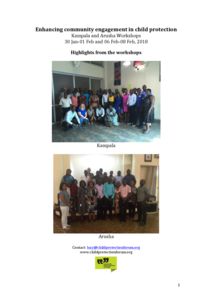
Enhancing community engagement in child protection Kampala and Arusha Workshops – Highlights from the workshops
Published: 2018
Author: Community Child Protection Exchange for the Interagency Learning Initiative (ILI)
A themes-focused report back of the workshops held in Kampala and Arusha 30 Jan-01 Feb and 06 Feb-08 Feb, 2018. These workshops were designed to create the time and space for practitioners in Uganda and Tanzania to reflect deeply on aspects of their own organisation’s community-based child protection work, learn about each others’ work and other evidence and learning, and to think about how they might employ some different approaches moving forward.
A Ugandan childhood: through the eyes of children and parents
Published: 2011
Author: Child Protection in Crisis Network
In 2011, 320 children from across Uganda participated in a consultation on the nature of childhood in the country. Drawn from urban and rural areas children shared their hopes as they described what they saw ‘doing well’ as a child to mean. Over 150 parents also indicated their own aspirations for their children.
Global Synthesis report of PLAN International’s support to community-based child protection mechanisms
Published: 2015
Author: Plan International
PLAN International’s review of its global programmes for community-based child protection. NB this is a very large file: 50MB
“Adapting to learn, learning to adapt”: Overview of and considerations for child protection systems strengthening in emergencies
Published: 2016
Author: Child Frontiers on behalf of the Systems Strengthening and Disaster Risk Reduction Task Force - co-led by the CPC Learning Network and Plan International
This review targets actors supporting child protection responses in humanitarian settings. The document aims to provide an overview of child protection systems strengthening in emergencies practice to date, and propose certain key considerations with regards to systems for child protection practitioners.
The impact of protection interventions on unaccompanied and separated children in humanitarian crises – Evidence brief
Published: 2017
Author: Williamson, K., Gupta, P., Gillespie, L.A., Shannon, H. and Landis, D. for Oxfam GB
The evidence brief of an independent systematic review, commissioned by the Humanitarian Evidence Programme which identifies, synthesizes and evaluates existing evidence of the impact of protection interventions.
The impact of protection interventions on unaccompanied and separated children in humanitarian crises – Full report
Published: 2017
Author: Williamson, K., Gupta, P., Gillespie, L.A., Shannon, H. and Landis, D. for Oxfam GB
The full report of an independent systematic review, commissioned by the Humanitarian Evidence Programme which identifies, synthesizes and evaluates existing evidence of the impact of protection interventions on unaccompanied and separated children (UASC) in humanitarian crises since 1983.
Community Action and the Test of Time: Learning from Community Experiences and Perceptions
Published: 2006
Author: Jill Donahue and Louis Mwewa
Case studies of mobilisation and capacity building to benefit vulnerable children in Malawi and Zambia.
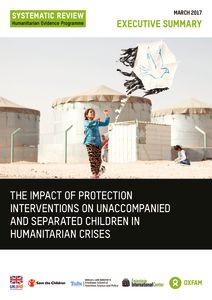
The impact of protection interventions on unaccompanied and separated children in humanitarian crises – Executive summary
Published: 2017
Author: Williamson, K., Gupta, P., Gillespie, L.A., Shannon, H. and Landis, D. for Oxfam GB.
The executive summary of an independent systematic review, commissioned by the Humanitarian Evidence Programme which identifies, synthesizes and evaluates existing evidence of the impact of protection interventions on unaccompanied and separated children (UASC) in humanitarian crises since 1983.
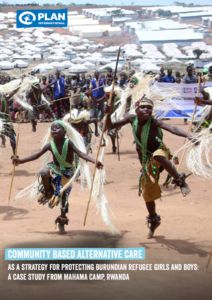
Community-based alternative care as a strategy for protecting Burundian refugee girls and boys: a case study from Mahama camp, Rwanda
Published: 2017
Author: Plan International
A case study which describes the community-based child protection programme implemented between 2015 and 2016 with Burundian girls, boys and adults in Mahama refugee camp in Rwanda.
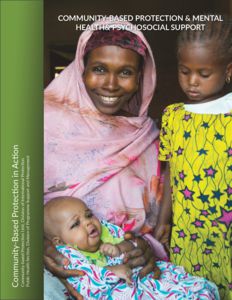
Community-based protection and mental health and psychosocial support
Published: 2017
Author: UNHCR
A report by UNHCR which seeks to help community-based protection actors and MHPSS practitioners understand the implications of their work for one another’s field of expertise including how they can collectively contribute to the wellbeing and protection of people affected by forced displacement.
Agencies, Communities and Children: a report of the Interagency Learning Initiative: Engaging Communities for Children’s WellBeing
Published: 2008
Author: Nicole Benham for the Interagency Learning Initiative
A report which aims to identify key issues, as a step toward the development of a broad consensus on good practice in engaging with communities to promote children’s safety and wellbeing.
Community engagement to strengthen social cohesion and child protection in Chad and Burundi – “Bottom Up” participatory monitoring, planning and action
Published: 2016
Author: International Institute for Child Rights and Development (IICRD), Dr. Philip Cook, Michele Cook, Natasha Blanchet Cohen, Armel Oguniyi & Jean Sewanou
A final report on action research which looked at how communities can help drive monitoring, planning and action around social cohesion strengthening and child protection in Chad and Burundi.
Presentation by James Kaboggoza – Child Protection Systems in Uganda
Published: 2016
Author: James Kobogozza
An overview of a recent mapping of child protection systems in Uganda.
Presentation by Eddy Walakira – Kampala workshop, 17-18 August, 2016
Published: 2016
Author: Eddy Walakira
This presentation looks at the results of a War Child Holland initiative in Northern Uganda around prevention of violence against children in a post war setting.
Agencies, Communities, and Children
Published: 2008
Author: Nicole Benham
A Report of the Interagency Learning Initiative: Engaging Communities for Children’s Well-Being.
This 2008 report, commissioned by an inter-agency steering committee and produced for review by the United States Agency for International Development’s Displaced Children and Orphans Fund, drew largely upon interviews with practitioners to draw out factors that both enable and constrain good practice with regards to working with community-based child protection and welfare groups.
Summary of studies undertaken on community based child protection mechanisms 2009-2014
Published: 2014
Author: Community Child Protection Exchange
A short round up of studies undertaken since the publication of the 2009 review “What are we learning about community based child protection mechanisms?” All the studies are hyperlinked.